
If you are comparing AC systems or trying to figure out why your electricity bill keeps climbing, you have probably run into the acronyms SEER, SEER2, and EER. They are not as complicated as they sound, and understanding them can genuinely save you money, both on your energy bills and when making repair versus replacement decisions.
Here is a plain-English breakdown of what each one means and why it matters for Tomball homeowners specifically.
What is the difference between EER and SEER2?
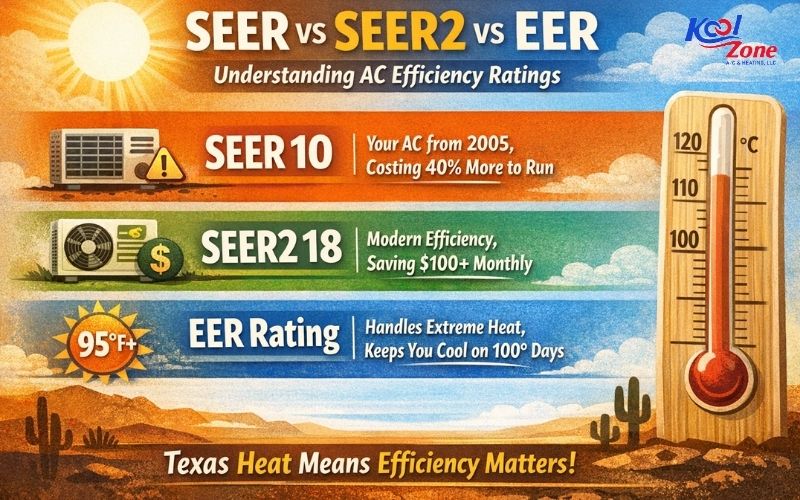
SEER (Seasonal Energy Efficiency Ratio) measures how efficiently your air conditioner cools over an entire average cooling season. Think of it like miles per gallon for your AC. A higher SEER number means better efficiency and lower operating costs. This was the industry standard for years, though it has now been replaced by more accurate measurements.
EER (Energy Efficiency Ratio) measures efficiency at a single specific high-temperature point, typically 95 degrees outdoor temperature with 80-degree indoor temperature and 50 percent humidity. This rating is especially relevant in places like Tomball where sustained peak temperatures are not occasional spikes but a regular summer reality. EER tells you how well your system performs when it is working its hardest.
SEER2 is the updated version of SEER, introduced in 2023 by the Department of Energy to better reflect real-world operating conditions. The updated testing protocol includes external static pressure to mimic actual ductwork resistance, which makes it a more accurate indicator of how your unit will actually perform in Texas weather rather than in ideal laboratory conditions. SEER2 is now the standard for evaluating new systems.
Is Seer the same as EER? Quick Reference: Understanding the Ratings
They are related but not the same. Here is the key difference:
SEER and SEER2 measure seasonal average efficiency across a range of conditions and temperatures. They are useful for understanding overall operating costs over a full cooling season.
EER measures efficiency at one specific high-load condition — the kind of conditions Tomball sees regularly from June through September. A system with a strong EER rating performs well when you need it most, not just on mild days.
For Tomball homeowners, both numbers matter. SEER2 gives you the best overall picture for comparing systems and estimating annual energy costs. EER tells you how the system performs during the stretches of extreme heat that define Texas summers.
As a general benchmark: a SEER2 rating of 16 or above is considered high efficiency for central AC. An EER of 12 or above is considered good, with 14 and above considered excellent.
Local Insight: Why Efficiency Ratings Matter for Tomball Homeowners
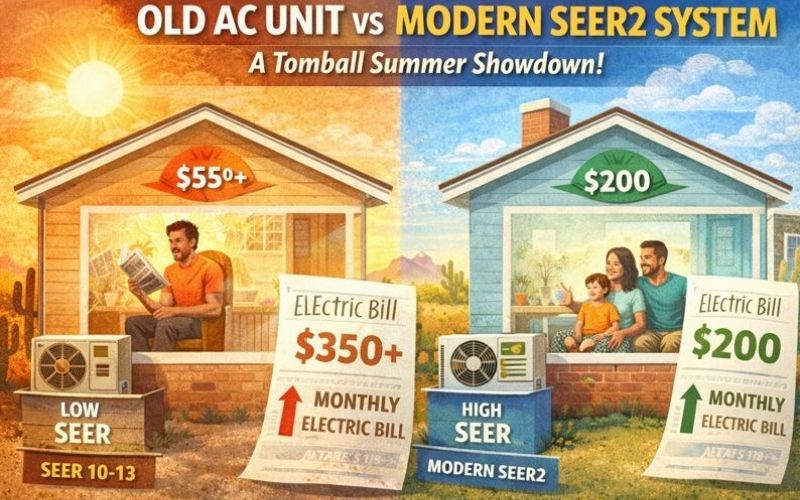
Tomball AC systems face demanding conditions. From June through September, temperatures regularly exceed 95 degrees and the humidity makes the heat index feel significantly worse. Older systems with SEER ratings of 10 to 13 struggle under these conditions, running longer cycles and working significantly harder to maintain comfortable indoor temperatures.
Local HVAC professionals consistently find that many Tomball systems installed before 2010 cost homeowners 30 to 40 percent more in energy consumption compared to modern SEER2-rated equipment. A system that costs $250 monthly to operate could potentially run $150 to $175 with a high-efficiency replacement, representing over $1,000 in annual savings.
If your system is past the 10-year mark and summer electricity bills are consistently running $300 to $400 or more despite conservative thermostat settings, it is worth getting an honest efficiency evaluation. The system may be costing you significantly more to operate than a replacement would cost to run.
AC Repair Tomball TX: How Efficiency Ratings Affect Your Repair Decisions
When your AC breaks down, the first thought is usually just to fix it. But experienced technicians consider your system’s efficiency rating when giving you a repair versus replacement recommendation, because it directly affects the math.
A simple framework:
Low SEER (10 to 13) plus expensive component failure: seriously consider replacement rather than investing in aging, inefficient equipment that will continue driving high energy costs even after the repair.
Mid-range SEER (14 to 16) plus a simple, affordable repair: keep your system running, especially if it is relatively young and well-maintained.
High SEER2 (17 and above): protect your investment with proper maintenance and necessary repairs. These efficient systems justify repair costs through their ongoing energy savings.
A $800 repair on a 12-year-old low-efficiency system rarely makes financial sense compared to putting that money toward a new system that pays for itself through reduced operating costs over time. Our repair vs replace guide walks through how to make that call.
What SEER rating is needed for tax credit 2025?
Under the Energy Efficient Home Improvement Credit (Section 25C of the tax code), homeowners can claim 30 percent of the cost of qualifying equipment, up to $600 for central air conditioning.
To qualify in 2025, central AC systems generally need to meet a minimum SEER2 of 16. Heat pump systems have separate requirements, typically a minimum SEER2 of 15.2 or EER2 of 11.7.
These thresholds can change, and your eligibility depends on your specific tax situation. When getting quotes for a new system, ask contractors specifically which models qualify for the 25C credit and confirm the current requirements with a tax professional before filing.
Many utility companies in the Greater Houston area also offer separate rebate programs for high-efficiency equipment that can stack with federal credits, so it is worth asking about both.
Understanding Real-World Performance vs. Laboratory Ratings
One thing worth knowing: SEER and SEER2 ratings represent maximum efficiency under specific test conditions, not guaranteed performance in your actual home. Several factors affect whether a system achieves its rated efficiency in practice.
Ductwork condition. Leaky or poorly insulated ductwork can reduce actual efficiency by 20 to 30 percent, negating much of the benefit from a high-SEER2 system. Any honest system evaluation should include a ductwork assessment.
Proper sizing. An oversized unit cycles on and off too frequently, reducing both efficiency and comfort. An undersized system runs constantly without adequately cooling. Correct sizing for your home’s specific square footage, insulation, and sun exposure is essential.
Installation quality. Even efficient equipment underperforms with a poor installation. Refrigerant charge, airflow calibration, and electrical connections all need to meet manufacturer specifications.
Maintenance consistency. Dirty coils, clogged filters, and skipped tune-ups reduce efficiency significantly over time. This is one of the clearest reasons our HVAC maintenance plans matter: two visits per year, diagnostic fees waived, and your system maintained at rated performance rather than slowly declining without you noticing.
What is considered a good EER rating?
For residential central air conditioning, an EER of 12 or above is generally considered good. An EER of 14 or above is excellent and worth paying a premium for if you are in a climate like Tomball’s where the system regularly operates under peak load conditions.
The higher the EER, the more efficiently your system runs during those 100-degree days in July and August when it is working hardest and your electricity costs are highest. In moderate climates, EER matters less because peak conditions are rare. In Tomball, peak conditions are the norm for months at a time, which makes EER a particularly useful number when comparing systems.
Pair a strong EER with a high SEER2 and you have a system that is efficient both during average conditions and during extreme heat. That combination translates directly to lower bills and less strain on components over the life of the system.
Making the Right Choice for Your Tomball Home
SEER, SEER2, and EER are not just numbers on a spec sheet. They represent the real difference between an AC system that keeps your home comfortable at a reasonable cost and one that runs constantly, underperforms on the hottest days, and costs more than it should to operate every month.
Understanding these ratings helps you make informed decisions about whether your current system deserves continued repair investment, whether a replacement makes financial sense, and which new equipment is worth what you are being asked to pay for it.
For more on choosing the right system for Texas weather, see our guide on the best AC brands for Texas.
Call Kool Zone at (713) 456-0793 or reach out through our contact page for a straightforward system evaluation and honest recommendations. You can also find us on Google Maps to read our reviews or get directions.